|
|||
|
Jean-Marc Castera
|
|||
|
Artist mathematician
|
|||
|
There is a non-periodic structure, identical to the simplest quasicrystals, in the background of traditional zellij paterns, those geometrical mosaics commons to the entire Islamic world which reached their apogee in Morocco and Andalusia. This is square rhombus tiling. After a short lecture presenting a method to discover, understand and practice the art of two dimensional geometrical arabesques, we will show the existence and role of this tiling. We will then see how this same tiling is used as the basis for the plans of muqarnas domes.We will conclude by showing some examples which are both continuations of the art of the arabesque, and which also depend on the research of the last decade concerning quasicrystals. A short computer-generated movie will be shown, which presents a summary of the morphogenesis of zellij motifs and a fractal development inspired by a mosaic in the Alhambra in Granada. |
|||
|
The
art of drawing geometric arabesques
|
|||
| This
section is presented in more detail in two publications by the author
of this paper (¹). They concern the geometric art of the entire Islamic
world, and especially that of Morocco and Andalusia. Some basic principles
: All proportions used to make the drawing are determined by geometric
necessities. Lines are continuous (never broken). Periodicity : the arbitrary
framework of the motif is like a a window that opens onto an abstract
landscape, that reproduces the same shape ad infinitum, by symmetrical
duplication. In practice, the monotony of repetition is avoided by the
vibrations that are introduced naturally when forms are created manually.
The interlace principle : above and bellow alternate. Colors : there is
symmetrical development, and alternation between the background and the
motif. Colors can enrich the motif by breaking down some symmetries while
respecting others. Finaly (but is it a principle ?) each of these rules
can be broken in certain situations. |
|||
 |
|||
|
Illustration of the metamorphosis principle. The motifs shown are all classical motifs. New pieces appear. |
|||
|
The concept of the skeleton. The Saft and the Seal of
Solomon are the basic pieces used. The alternation of these two pieces
creates polygonal bands with multiple 45-degree angles. When the band
is closed it can be considered a skeleton. The motifs appear when the
free lines running toward the center meet, respecting the principles
of continuity and symmetry. In this way we can rediscover traditional
motifs, beginning from the simplest skeletons. In the same way the collection
of pieces used is growing.
|
|||
|
|
|||
|
Alternation Saft-Seal of Solomon, and formation of skeletons |
|||

|
|||
|
Left, a graphical hypothesis : a star octagon skeleton. Middle and right : two resolutions, or embellishments, of this skeleton. |
|||
| This is how the motifs of the largest family
of traditional geometric motifs appear, based on octagonal symmetry. Other
new principles need to be added for larger stars, containing from 16 to
96 points, but we will not discuss them here. |
|||
|
Non-periodic tilling
|
|||
| Skeletons can be considered to be built on
an isometric polygonal network made up of squares and diamonds. This structure
is in fact a non-periodic tiling, simpler than the original Penrose tiling.
It was in a Beijing laboratory in 1987, that physicists discovered a quasicrystal
that had a similar 3 dimensional structure, with an eightfold local symmetry
(²). |
|||
 |
|||
Skeleton of a 64-pointed star, inside a non-periodic square-diamond tiling |
|||
|
Muqarnas
|
|||
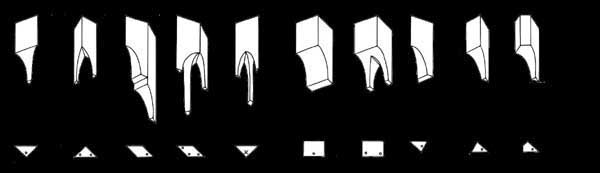
| We will limit our presentation
to the modular style of Muqarnas seen in Morocco and Andalusia. The most
complex muqarnas domes can be made using just 12 different types of pieces,
5 of which are the main pieces used. These are small modules of painted
cedar, or sculpted pieces of molded plaster that are sometimes highlighted
with colors. These modules, cut at 45 degree angles, on diamond shapes,
half squares or rectangles, are assembled using natural rules of continuity.
The works are assembled while flat, and the elevation of the work is deducted
from the height of just one piece. |
|||
 |
|||
|
The main pieces used for muqarnas and their flat projections |
|||
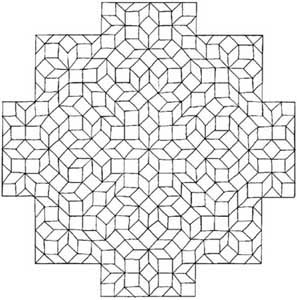
| If we examine the dome shown below, it can
be seen that diamond-square tiling is used as the basic structure. Squares
are naturally broken down into pairs of triangles, and some square-diamond
groups are replaced by assemblies containing rectangles. |
|||
|
|||
Natanz, funerary assembly of 'Abd al Sahem. Analysis of the plan of the dome as a square-diamond network. |
|||
 |
|||
|
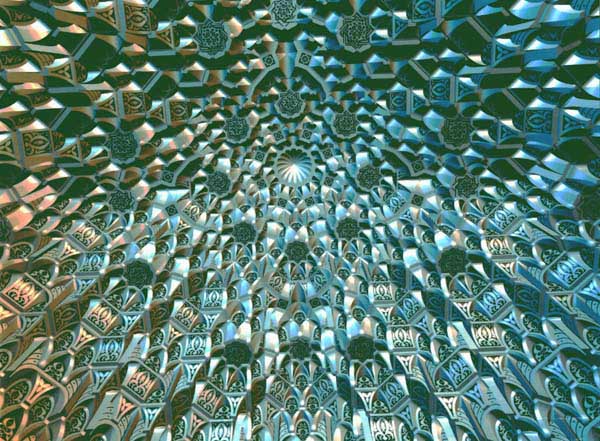
Applications: a new dome, (computer-generated image) |
|||
|
Experimental continuations
|
|||
| The motif at the top left of the below drawing
(1) is a traditional motif built around a 10-pointed star that is very
common in Islam. It is actually the simplest 10-pointed star. Its minimal
reduction is a half-rectangle, and, conversely, this half-rectangle will
only produce this motif, and none other, when it is reproduced by symmetry.
However, if we consider it as having been made of diamonds (2), we can
see that this diamond is none other than one of the two pieces of the
Penrose tiling. This will lead us to a complementary decoration by continually
extending its lines. This means that this traditional motif can be extended
non-periodically to create an infinite number of combinations. |
|||
 |
|||
By cutting two-dimensional slices of a hyperspace with a dimension of X, tiled with a simple periodic network of hypercubes, André Katz and Denis Gracias (³) produced non-periodic tilings made of diamonds (the number of different diamonds is equal to the whole integer of half of X). These diamonds can be broken down into "generalized muqarnas" pieces with unexpected symmetries. This is how the above dome was designed, starting with a Penrose type tiling which came from a hyperspace with a dimension of 5. In the Qarawiyin Mosque, in Fes, Morocco, there is a small dome with fivefold symmetry, but this is the only example we have found as yet. |
|||
 |
|||
|
A new type of dome, with fivefold symmetry |
|||
| In the same manner, we will present zellij
motifs with local sevenfold symmetry, built along fractal developments,
with no axis of plane symmetry. |
|||
| Notes |
|||
(¹) J.M Castera et H.
Jolis, "Géométrie douce", Atelier 6 ½, Paris 1992. J.M Castera,"Arabesques",
ACR, 1996. (²) Ke Xin Kuo, "Les plus simples des quasi-cristaux" La
Recherche n°193, November 1987. (³) A. Katz et M. Duneau, : "Paver l'espace
: un jeu mathématique pour les physiciens" La Recherche n° 167, June
1985. D. Gratias, "Les quasi-cristaux", La Recherche n°178, June 1986.
|
|||
 retour